
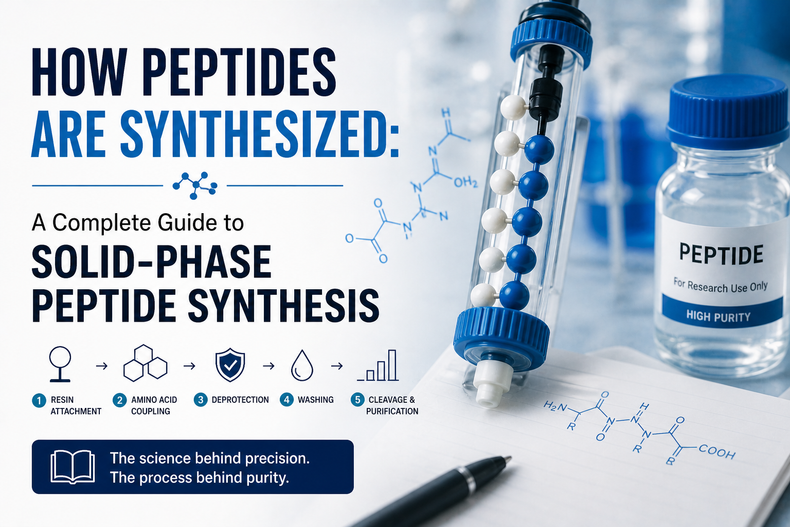
Peptide synthesis sits at the crossroads of chemistry, biology, and medicine. Understanding exactly how peptides are built in the lab, one amino acid at a time, reveals why this technology has transformed modern research and pharmaceutical development.
1. What Are Peptides?
Peptides are short chains of amino acids linked together by peptide bonds, covalent connections formed between the carboxyl group of one amino acid and the amino group of the next. They are structurally and functionally distinct from proteins, which are typically longer, more complex chains that fold into defined three-dimensional shapes.
In biological systems, peptides act as molecular messengers. Hormones such as insulin, oxytocin, and glucagon are all peptides. So are many antimicrobial compounds produced by the immune system, and a growing class of drugs used in oncology and metabolic disease.
A peptide containing fewer than roughly 50 amino acids is generally classified as a peptide; longer chains begin to enter the domain of proteins. This boundary is somewhat arbitrary, what matters functionally is sequence, structure, and biological activity.
2. Why Do Scientists Synthesize Peptides?
The body manufactures peptides through ribosomal translation, reading messenger RNA and assembling amino acids in sequence. This process, while elegant, is difficult to replicate or control in a laboratory for research purposes. Synthetic chemistry offers an alternative: build the peptide directly, with full control over sequence, length, and chemical modifications.
Researchers synthesize peptides for a wide range of scientific purposes:
- Drug discovery and development — testing candidate therapeutic sequences before clinical trials
- Structural biology — studying how specific sequences fold and interact with other molecules
- Diagnostic tool development — creating peptide antigens for antibody production and immunoassay development
- Vaccine research — using peptide fragments that mimic viral or bacterial surface proteins
- Neuroscience and hormone research — investigating signaling pathways at the molecular level
A single incorrect amino acid in a peptide sequence can eliminate biological activity entirely or produce unintended effects. This is why reproducible, well-characterized synthesis methods are essential for rigorous scientific research.
3. What Is Solid-Phase Peptide Synthesis (SPPS)?
Solid-Phase Peptide Synthesis (SPPS) is a laboratory method in which a peptide chain is assembled while anchored to a solid, insoluble support, typically a polymer resin bead. Amino acids are added sequentially, one at a time, to the growing chain.
The technique was pioneered by Dr. Robert Bruce Merrifield at Rockefeller University in 1963. His innovation solved a fundamental problem in peptide chemistry: purification. In solution-phase synthesis, each amino acid addition requires isolating an intermediate product, a laborious process prone to yield losses. By tethering the growing chain to a solid support, excess reagents and byproducts can simply be washed away after each step, dramatically simplifying purification.
Merrifield's work was recognized with the Nobel Prize in Chemistry in 1984. Today, SPPS is the dominant method for producing synthetic peptides in both research and pharmaceutical manufacturing contexts.
4. Step-by-Step: How SPPS Works
The SPPS cycle follows a well-defined sequence of steps that repeats for each amino acid in the target sequence. Here is how the process unfolds from start to finish:
The C-terminal amino acid of the target sequence is chemically attached to the solid resin support. This anchors the chain and provides the foundation for all subsequent additions. Resin choice (such as Wang resin or Rink Amide resin) affects the final C-terminus of the peptide.
Amino acids have multiple reactive functional groups. To prevent unwanted side reactions during coupling, these groups are chemically blocked with protecting groups. The alpha-amine (the site of chain extension) is temporarily protected, while side-chain protecting groups remain in place throughout the entire synthesis.
The protecting group on the alpha-amine of the resin-bound amino acid is selectively removed, a step called deprotection. This exposes the reactive site where the next amino acid will attach, opening the chain for the next coupling cycle.
The next amino acid in the sequence, itself carrying a protected alpha-amine, is activated using a coupling reagent (such as HATU, DIC, or HBTU) and added to the reaction vessel. The activated carboxyl group reacts with the free amine on the resin-bound chain, forming a new peptide bond. This step is called coupling.
After each coupling step, the resin is washed extensively with solvents (typically DMF, DCM, or NMP) to remove unreacted amino acids, excess coupling reagents, and byproducts. Thorough washing is critical to prevent sequence errors caused by residual reagents.
Steps 3 through 5 (deprotect → couple → wash) are repeated for every amino acid in the target sequence. A 30-amino-acid peptide requires 30 complete cycles. Each cycle adds one residue to the growing N-terminus of the chain.
Once the full sequence is assembled, the completed peptide is cleaved from the resin using a cleavage cocktail, typically trifluoroacetic acid (TFA) for Fmoc chemistry, or hydrogen fluoride (HF) for Boc chemistry. This step also removes most or all of the side-chain protecting groups simultaneously.
The crude peptide is purified, most commonly by reverse-phase High-Performance Liquid Chromatography (RP-HPLC). This separates the target peptide from truncated sequences, deletion products, and other impurities generated during synthesis. Research-grade peptides are typically required to be greater than 95% pure by HPLC analysis.
5. Fmoc vs Boc Chemistry
Two main protecting group strategies are used in SPPS. They are named after the chemical group used to protect the alpha-amine during synthesis.
| Feature | Fmoc Chemistry | Boc Chemistry |
|---|---|---|
| Deprotection reagent | Piperidine (mild base) | Trifluoroacetic acid (TFA; strong acid) |
| Cleavage reagent | TFA-based cocktail | Hydrofluoric acid (HF) |
| Safety profile | Milder conditions; standard lab setup | Requires HF-specific equipment and safety protocols |
| Automation compatibility | Excellent — widely automated | Limited — HF handling complicates automation |
| Best suited for | Most standard sequences; large-scale production | Difficult sequences; sequences prone to aspartimide formation |
| Industry adoption | Dominant in modern research and manufacturing | Specialized research settings |
Fmoc chemistry has become the standard in most modern laboratories due to its milder reagent requirements, compatibility with automation, and broad applicability. Boc chemistry remains important for specific sequences that Fmoc handles poorly, and for researchers working with established Boc-based protocols in specialized contexts.
6. Key Tools and Reagents
Successful SPPS depends on a set of specialized materials, each serving a distinct function in the synthesis cycle:
Solid Support (Resin)
Polymer beads, most commonly polystyrene or PEG-based, provide the physical scaffold to which the first amino acid is anchored. Resin choice influences swelling properties (and thus reagent penetration), loading capacity, and the chemistry of the final C-terminus.
Protecting Groups
Temporary protecting groups (Fmoc or Boc) shield the alpha-amine between coupling steps. Permanent side-chain protecting groups (such as tBu, Pbf, or Trt) remain in place until final cleavage, preventing unwanted reactions at chemically reactive residues like cysteine, lysine, or aspartic acid.
Coupling Reagents
These reagents activate the carboxyl group of the incoming amino acid, enabling efficient peptide bond formation. Common choices include HATU, HBTU, DIC (with Oxyma or HOBt), and PyBOP. Reagent selection influences coupling efficiency, racemization risk, and cost.
Solvents
Dimethylformamide (DMF) and dichloromethane (DCM) are the most common synthesis solvents. N-methyl-2-pyrrolidone (NMP) is used for difficult sequences. Proper solvent choice affects resin swelling and reagent solubility.
Cleavage Cocktails
At the end of synthesis, a mixture of TFA with scavengers (such as water, triisopropylsilane, or thioanisole) cleaves the peptide from the resin and removes side-chain protecting groups simultaneously. Scavengers trap reactive cations released during cleavage to prevent modification of sensitive residues.
Automated Peptide Synthesizers
Modern peptide synthesizers automate the deprotect–couple–wash cycle, running reactions overnight with minimal manual intervention. This dramatically improves reproducibility and throughput, particularly for longer or more complex sequences.
7. Quality Control: How Scientists Verify Peptides
Synthesis is only half the process. Every peptide produced for research use must be rigorously characterized to confirm sequence integrity, purity, and identity before use in experiments.
High-Performance Liquid Chromatography (HPLC)
Reverse-phase HPLC is the gold standard for peptide purity analysis. The peptide sample is passed through a column under controlled conditions, separating components by hydrophobicity. The resulting chromatogram shows the relative abundance of each component, expressed as a percentage purity. Research-grade peptides typically require ≥95% purity; pharmaceutical applications often demand ≥99%.
Mass Spectrometry (MS)
Mass spectrometry confirms molecular identity by measuring the precise mass-to-charge ratio of the peptide. This verifies that the correct sequence was assembled, detects deletion or insertion errors, and can identify chemical modifications introduced during synthesis (such as oxidation of methionine or deamidation of asparagine).
Both HPLC purity data and mass spectrometry confirmation should accompany any research-grade peptide. A certificate of analysis (CoA) documenting these results allows researchers to assess suitability for their specific experimental application before use.
8. Advantages and Limitations of SPPS
- Fully automatable; reduces manual intervention and human error
- Excess reagents are washed away, no need to isolate intermediates
- Compatible with a wide range of natural and non-natural amino acids
- Scalable from microgram research quantities to kilogram pharmaceutical batches
- Allows incorporation of chemical modifications (fluorescent labels, PEG chains, D-amino acids)
- Reproducible results when protocols are optimized
- Difficult sequences (>50 residues) often show reduced yields and purity
- Certain sequence motifs (e.g., aggregation-prone segments) cause coupling failures
- Raw material costs (amino acids, coupling reagents, resins) can be significant
- Requires specialized equipment and trained personnel for optimal results
- Cumulative step yields mean even small per-step inefficiencies compound significantly
Despite these limitations, SPPS remains the gold standard for custom peptide production. Ongoing advances in resin technology, coupling chemistry, and microwave-assisted synthesis continue to push the boundaries of what sequences can be reliably produced.
9. Real-World Applications of Synthetic Peptides
The ability to synthesize peptides precisely and reproducibly has had far-reaching impact across multiple fields of science and medicine.
Pharmaceutical Development
Synthetic peptides form the basis of numerous approved drugs. Insulin, the first biologically active peptide produced synthetically at scale, transformed diabetes care. Peptide-based drugs are now used across oncology (such as octreotide for neuroendocrine tumors), infectious disease (enfuvirtide for HIV), cardiovascular disease, and beyond. GLP-1 receptor agonists, a drug class including semaglutide, are among the most commercially significant peptide-derived therapeutics in current use.
Vaccine Antigen Research
Synthetic peptide antigens allow researchers to study immune responses to specific epitopes, small, precisely defined fragments of pathogen surface proteins. This approach is fundamental to developing subunit vaccines and understanding protective immunity at the molecular level.
Diagnostic Assays
Peptides serve as antigens in enzyme-linked immunosorbent assays (ELISAs) and other immunoassay formats. Because synthetic peptides can be produced with high consistency and purity, they provide reliable, reproducible standards for diagnostic testing.
Structural and Chemical Biology
Researchers use synthetic peptides to map protein–protein interaction sites, study enzyme substrate specificity, develop protease inhibitors, and probe the relationship between amino acid sequence and secondary structure. Non-natural amino acid incorporation, only possible via SPPS, enables studies that would be inaccessible through biological expression systems.
Antimicrobial Research
Antimicrobial peptides (AMPs) represent a class of naturally occurring defense molecules with potential as alternatives or adjuncts to conventional antibiotics. Synthetic production allows systematic variation of AMP sequences to optimize potency, selectivity, and stability.
Key Takeaways
- Peptides are short amino acid chains that act as biological messengers, hormones, and drug candidates.
- Solid-Phase Peptide Synthesis (SPPS), invented by Merrifield in 1963, is the standard method for producing synthetic peptides.
- The SPPS cycle, deprotect, couple, wash, repeats for every amino acid in the sequence.
- Fmoc chemistry dominates modern labs; Boc chemistry is used for specific difficult sequences.
- HPLC and mass spectrometry are essential for verifying peptide purity and identity.
- Synthetic peptides underpin drug development, vaccine research, diagnostics, and structural biology.
- SPPS is highly reliable for sequences up to ~50 residues; longer peptides present increasing technical challenges.
Frequently Asked Questions
The distinction is primarily one of length. Peptides are generally defined as chains of fewer than approximately 50 amino acid residues. Proteins are longer chains that typically fold into defined three-dimensional structures. The boundary is not rigid, some molecules in the 30–100 residue range are classified differently depending on context.
In SPPS, the growing peptide chain is tethered to a solid resin, which means excess reagents and byproducts can be removed by simple washing rather than by isolation of intermediates. This dramatically reduces the number of purification steps required, improves yield, and enables automation. Solution-phase synthesis is still used for industrial-scale production of some short peptides but is generally less practical for complex sequences.
Amino acids contain multiple chemically reactive groups, not just the alpha-amine and carboxyl groups that form the peptide backbone, but also side chains on residues such as lysine, serine, cysteine, and glutamic acid. Without protecting groups chemically blocking these reactive sites, multiple undesired reactions would occur simultaneously, producing a mixture of incorrect products. Protecting groups are added before synthesis begins and removed either stepwise (temporary groups) or at final cleavage (permanent side-chain groups).
The timeline depends on length and complexity. A short peptide of 10–20 residues can be assembled in a matter of hours using an automated synthesizer. Longer or more complex sequences may take one to several days. Purification and quality control analysis add additional time, typically one to three days for routine peptides, longer for complex or large-scale productions.
Common failure modes include incomplete coupling (leaving unreacted amine sites that produce deletion sequences), incomplete deprotection, aggregation of the growing chain on the resin (which blocks access to the reactive terminus), side-chain reactions at unprotected residues, and racemization during activation. Each of these can reduce yield and purity. Monitoring coupling efficiency at each step and optimizing conditions for challenging sequences are essential practices in high-quality peptide production.
SPPS was invented by Dr. Robert Bruce Merrifield at Rockefeller University in 1963. He published the foundational methodology that year and received the Nobel Prize in Chemistry in 1984 for this contribution, which the Nobel Committee described as revolutionizing the synthesis of biologically active compounds.