
Introduction
You ordered a peptide. It arrived in the lab. Now what should you do first?
Before running any experiment, there is one document you should always read. That document is the Certificate of Analysis, often called the COA.
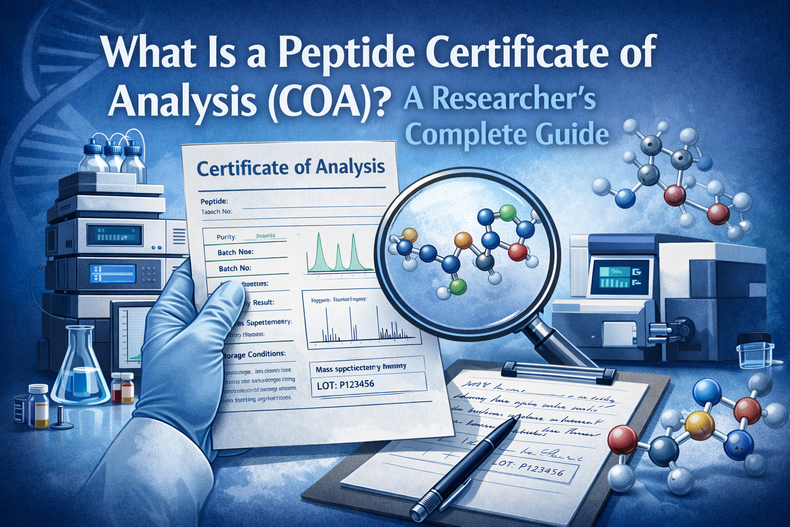
A peptide certificate of analysis is more than a simple document. It is the official report that shows the quality of the peptide you received. It tells you the purity, identity, batch information, and testing results.
For researchers, this document acts like a quality passport for the peptide.
If the COA looks correct, you can move forward with confidence. If something looks wrong, it may prevent serious problems later.
In this guide, we will explain what a peptide COA is, why it matters, and how researchers read and use it.
What Is a Peptide Certificate of Analysis?
A peptide certificate of analysis (COA) is an official document provided by the peptide manufacturer or supplier.
It summarizes the analytical tests performed on a specific batch of peptide.
You can think of it as the peptide’s report card. It shows:
-
what tests were performed
-
what results were obtained
-
whether the peptide passed quality standards
Each batch of peptide has its own COA. This ensures the results apply to the exact material inside the vial.
A trustworthy peptide supplier always provides a COA. If a supplier cannot provide one, that is a serious warning sign.
Why the Peptide COA Is Important
Scientific research depends on accuracy. Even a small mistake in your materials can affect the results of an entire study.
If a peptide is impure or incorrectly identified:
-
experiments may fail
-
results may become misleading
-
studies may not be reproducible
A peptide certificate of analysis helps avoid these problems.
It allows researchers to:
-
confirm the peptide’s identity
-
verify the purity level
-
check the molecular weight
-
confirm the batch information
In other words, the COA helps researchers know exactly what they are working with.
This protects both the research project and the researcher’s scientific reputation.
What Information Appears on a Peptide COA?
Although the layout may differ between laboratories, most peptide COAs contain similar sections.
Understanding these sections helps researchers evaluate peptide quality.
Product Identification
The first section identifies the peptide.
This usually includes:
-
peptide name
-
catalogue number
-
amino acid sequence
-
molecular formula
-
molecular weight
-
physical appearance
The appearance may be described as:
-
white powder
-
off-white powder
-
lyophilised powder
Researchers should always confirm that the peptide sequence matches what they ordered. Even a small change in sequence creates a completely different peptide.
Batch or Lot Number
Each peptide production run receives a lot number or batch number.
This number identifies the exact production batch.
Batch numbers are important for traceability. If a problem appears later, the supplier can trace it back to the specific batch.
Researchers should always record the batch number in their lab notebook or experiment records.
Purity Results
One of the most important parts of a COA is the purity percentage.
Purity shows how much of the sample contains the correct peptide.
For example:
Purity: >95%
This means more than 95% of the sample is the intended peptide. The rest may include small impurities.
Purity is usually measured using High-Performance Liquid Chromatography (HPLC).
Typical purity expectations include:
-
85% or higher – basic research or early screening
-
95% or higher – standard research use
-
98% or higher – clinical or highly sensitive studies
Higher purity usually means more reliable results.
Understanding HPLC Results in a COA
HPLC is the most common method used to measure peptide purity.
During HPLC testing:
-
The peptide sample is dissolved in liquid.
-
The sample passes through a column.
-
Different compounds separate as they move through the column.
-
A detector records each compound.
The output is a graph called an HPLC chromatogram.
How to Read an HPLC Chromatogram
The chromatogram contains several peaks.
-
The X-axis shows retention time (minutes).
-
The Y-axis shows signal intensity.
The largest peak represents the main peptide.
Smaller peaks represent impurities.
Researchers calculate purity by comparing the area of the main peak with the total area of all peaks.
If the main peak represents 95% of the area, the peptide purity is 95%.
Mass Spectrometry Confirmation
Another critical section of a peptide COA is Mass Spectrometry (MS) data.
Mass spectrometry confirms the identity of the peptide.
Every peptide has a unique molecular weight based on its amino acid sequence.
The COA usually shows two values:
-
Theoretical molecular weight – calculated from the sequence
-
Observed molecular weight – measured by the instrument
These numbers should match closely.
If they differ significantly, the peptide may have been incorrectly synthesized or labeled.
Mass spectrometry therefore confirms that the peptide is exactly what the supplier claims it is.
Water and TFA Content
Some COAs include information about moisture and residual chemicals.
Peptides are usually supplied as lyophilised (freeze-dried) powders. During production, small amounts of water or chemicals may remain.
The COA may list:
-
Moisture content (%)
-
TFA content (%)
TFA stands for trifluoroacetic acid, which is often used during peptide purification.
This information matters because it affects the true peptide weight in the sample.
Solubility Information
Some peptide COAs include solubility data.
This tells researchers which solvents dissolve the peptide and at what concentration.
Example:
“Soluble in water at 1 mg/mL.”
This information helps researchers prepare peptide solutions correctly.
Storage and Stability Information
Peptides are sensitive molecules. They can degrade if stored incorrectly.
That is why COAs often include storage instructions.
Typical recommendations include:
-
store at −20°C for long-term storage
-
store at 4°C for short-term storage
-
avoid repeated freeze-thaw cycles
-
protect from light and moisture
Following these guidelines helps maintain peptide quality.
Red Flags to Watch for on a COA
Not all COAs are reliable. Researchers should watch for warning signs.
Common red flags include:
-
purity below 90%
-
missing mass spectrometry data
-
theoretical and observed molecular weight do not match
-
missing batch number
-
unclear testing methods
-
missing manufacturing or analysis date
If these issues appear, researchers should contact the supplier before using the peptide.
COA vs Specification Sheet
Researchers sometimes confuse a Certificate of Analysis with a specification sheet.
These documents serve different purposes.
A specification sheet describes what the product should contain.
A COA shows the actual test results for a specific batch.
For research purposes, the COA is far more important because it shows real testing data.
Best Practices for Researchers
Good laboratory practice includes proper documentation.
Researchers should follow several habits when working with peptide COAs.
-
Save both digital and printed copies of every COA.
-
Record the batch number in experiment notes.
-
Review the COA before starting a new experiment.
-
Do not use peptides if purity is below your required level.
-
Investigate any difference between theoretical and observed molecular weight.
These simple steps help keep research accurate and reproducible.
Common COA Terms Explained
Here are some common terms found in peptide COAs.
HPLC
High-Performance Liquid Chromatography used to measure purity.
Mass Spectrometry (MS)
Technique used to confirm peptide molecular weight.
MW (Molecular Weight)
The mass of the peptide molecule.
Purity (%)
Percentage of the sample that contains the target peptide.
Lot or Batch Number
Unique identifier for a specific production run.
TFA
Trifluoroacetic acid used during peptide purification.
Lyophilised
Freeze-dried form of the peptide for stability.
COA
Certificate of Analysis showing testing results.
Final Thoughts
A peptide certificate of analysis is not just paperwork. It is a key part of responsible scientific research.
Before using a peptide in any experiment, researchers should carefully review the COA.
Check the purity. Confirm the molecular weight. Verify the sequence. Record the batch number.
These steps only take a few minutes, but they can prevent weeks or months of failed experiments.
Good science begins with reliable materials.
And reliable materials always come with a clear and trustworthy Certificate of Analysis.