
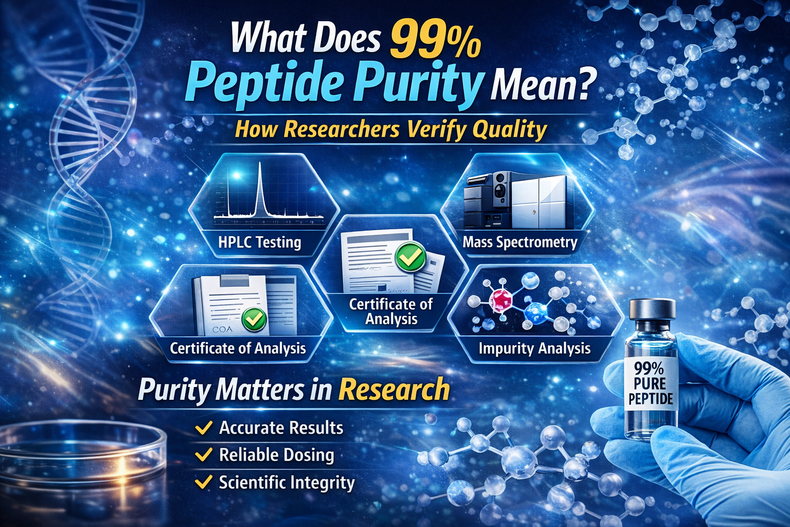
A Practical, Research-Focused Guide to Peptide Purity, Testing Methods, and Quality Verification
Table of Contents
-
Introduction: Why Peptide Purity Is Not Just a Number
-
What Is Peptide Purity?
-
What Does 99% Peptide Purity Actually Mean?
-
Common Peptide Purity Grades in Research
-
What Makes Up the Remaining 1%?
-
Why Peptide Purity Matters in Scientific Research
-
How Researchers Verify Peptide Purity
-
Understanding a Peptide Certificate of Analysis (COA)
-
Why Third-Party Peptide Testing Matters
-
How Researchers Can Verify Peptide Quality Before Use
-
When Is 99% Peptide Purity Necessary?
-
Research Use Disclaimer
-
Final Thoughts
-
Frequently Asked Questions
Key Takeaways
-
99% peptide purity means that nearly all detected peptide material corresponds to the intended amino acid sequence.
-
The remaining 1% may still affect experimental outcomes, especially in sensitive biological assays.
-
High-Performance Liquid Chromatography (HPLC) and Mass Spectrometry (MS) are the primary analytical methods used to verify peptide purity and identity.
-
Peptide purity is not the same as peptide content because counterions and salts can affect total mass.
-
A Certificate of Analysis (COA) and third-party testing are essential for confirming peptide quality.
-
High-purity peptides improve experimental reproducibility, dosing accuracy, and data reliability.
Introduction: Why Peptide Purity Is Not Just a Number
In peptide research, purity is not a marketing claim—it is a scientific variable that directly affects experimental accuracy, reproducibility, and data interpretation.
When a supplier advertises 99% peptide purity, many researchers assume the compound is essentially perfect. However, the remaining 1% of impurities can significantly influence biological activity, receptor binding, stability, and dosing precision.
Research peptides are widely used in:
-
biomedical research
-
receptor signaling studies
-
enzyme modulation experiments
-
drug discovery programs
-
pharmacokinetic analysis
In these environments, even trace impurities can introduce variability and produce misleading results.
This guide explains:
-
what 99% peptide purity actually means
-
how laboratories verify peptide quality
-
how researchers evaluate peptide purity and analytical data
Understanding these principles helps researchers protect the integrity of their experiments.
What Is Peptide Purity?
Peptide purity refers to the percentage of the peptide sample that consists of the correct amino acid sequence relative to other peptide-related components produced during synthesis.
During solid-phase peptide synthesis (SPPS), several by-products can form alongside the intended sequence. Analytical testing is required to determine how much of the final material contains the correct peptide structure.
In Simple Terms
A peptide labeled 99% pure means:
-
99% of detected peptide material corresponds to the intended sequence
-
Up to 1% consists of peptide-related impurities
These impurities may include:
-
truncated peptide chains
-
deletion sequences
-
amino acid substitutions
-
oxidized residues
-
synthesis by-products
Even at very low levels, these impurities can influence biological experiments and quantitative measurements.
What Does 99% Peptide Purity Actually Mean?
The 99% purity value is typically determined using High-Performance Liquid Chromatography (HPLC).
HPLC separates molecules based on chemical interactions and produces a chromatogram with peaks representing different components.
Purity is calculated by comparing the area of the main peptide peak to the total area of all detected peaks.
However, this measurement has an important limitation.
HPLC Purity Does Not Always Include
-
counterions such as TFA or acetate
-
residual water
-
trace organic solvents
As a result, a peptide that is 99% pure by HPLC may only contain 85–90% peptide by total mass.
This distinction is why researchers must evaluate both:
-
peptide purity
-
peptide content
Common Peptide Purity Grades in Research
Research peptides are commonly categorized into several purity tiers.
Crude Peptides (30–70%)
-
minimal purification
-
high levels of synthesis by-products
-
suitable only for early screening
Desalted Peptides (70–85%)
-
salts removed
-
still contains substantial peptide impurities
Standard Research Grade (>95%)
-
acceptable for many routine in vitro experiments
High Purity (>98%)
Recommended for:
-
receptor binding studies
-
dose-response experiments
-
in vivo research
Ultra-High Purity (>99%)
Required for:
-
structural biology
-
pharmacokinetics
-
immunogenicity testing
-
publication-critical research
What Makes Up the Remaining 1%?
The remaining 1% is not random contamination. Most impurities are chemically related peptides produced during synthesis.
Common Peptide Impurities
-
deletion sequences (missing amino acids)
-
truncated peptides
-
amino acid substitutions
-
oxidized residues
-
aggregated or dimerized peptides
-
residual synthesis reagents
Because these molecules are structurally similar to the target peptide, they may still interact with biological systems.
This is why even small impurity levels can influence research outcomes.
Why Peptide Purity Matters in Scientific Research
1. Experimental Reproducibility
Impurity profiles may vary between peptide batches. These differences can lead to inconsistent results across experiments.
2. Dose Accuracy
If salts or counterions contribute significant mass, the actual peptide concentration may be lower than expected.
This can distort pharmacological data.
3. Biological Specificity
Impurities may act as:
-
partial agonists
-
antagonists
-
nonspecific binders
These effects are particularly important in receptor-based assays.
4. Safety and Immunogenicity
Modified peptides or aggregates may trigger immune responses in biological systems, complicating preclinical studies.
How Researchers Verify Peptide Purity
1. High-Performance Liquid Chromatography (HPLC)
HPLC is the primary analytical technique used to measure peptide purity.
How it works
-
peptides are separated by chemical interactions
-
each component produces a peak
-
purity is calculated from peak areas
High-purity chromatogram
-
one dominant peak
-
minimal secondary peaks
Limitations
-
structurally similar peptides may co-elute
-
HPLC measures purity but not identity
2. Mass Spectrometry (MS)
Mass spectrometry verifies the molecular weight and identity of a peptide.
MS confirms:
-
correct molecular mass
-
sequence consistency
-
presence of deletion variants
HPLC + MS together provide reliable peptide verification.
3. Additional Analytical Methods
Advanced research may also use:
-
Amino Acid Analysis (AAA)
-
NMR spectroscopy
These techniques help confirm peptide composition and structural integrity.
What Is a Certificate of Analysis (COA)?
A Certificate of Analysis (COA) is the official document verifying peptide testing results.
A legitimate COA should include:
-
peptide name and sequence
-
purity percentage and analytical method
-
HPLC chromatogram
-
mass spectrometry data
-
peptide content and counterion specification
-
batch number and testing date
A generic or template COA is a major quality red flag.
Why Third-Party Peptide Testing Matters
Independent testing provides several advantages:
-
reduces supplier bias
-
confirms analytical accuracy
-
improves transparency
-
aligns with scientific best practices
Reputable peptide suppliers often provide third-party verified COAs for every batch.
How Researchers Can Verify Peptide Quality Before Use
Before starting experiments, researchers should confirm:
-
batch-specific Certificate of Analysis
-
HPLC purity data
-
mass spectrometry identity verification
-
peptide content vs counterion mass
-
proper storage instructions
Avoid suppliers that rely on vague labels such as:
-
“lab grade”
-
“premium purity”
-
“high quality”
without analytical documentation.
When Is 99% Peptide Purity Necessary?
99%+ Purity Recommended For
-
pharmacokinetic studies
-
dose-response experiments
-
EC50 / IC50 testing
-
in vivo studies
-
immunogenicity assessments
-
structural biology
-
publication-grade research
Lower Purity May Be Acceptable For
-
early screening experiments
-
exploratory research
-
robust cell assays with large signal changes
The higher the stakes of the experiment, the higher the required purity.
Research Use Disclaimer
All peptides referenced in this article are intended for research and laboratory use only.
They are not approved for human or veterinary consumption.
Researchers are responsible for ensuring regulatory compliance and proper laboratory handling.
Final Thoughts: Purity Is Part of Experimental Design
A 1% difference in peptide purity may seem small, but in research environments, small variables can compound into major outcomes.
High-purity peptides help researchers:
-
improve experimental reproducibility
-
increase confidence in data
-
reduce costly experimental errors
Understanding peptide purity, testing methods, and documentation enables scientists to select reliable research materials.
In peptide science, purity is not an upgrade—it is a requirement.
Frequently Asked Questions (FAQ)
What does 99% peptide purity mean?
A peptide labeled 99% purity means that about 99% of the detected peptide material matches the intended amino acid sequence, usually verified using High-Performance Liquid Chromatography (HPLC). The remaining 1% consists of synthesis-related impurities.
Is 99% peptide purity considered research-grade?
Yes. 99% purity is generally considered high-quality research grade. It is commonly used in advanced experiments such as receptor binding studies, pharmacokinetics, and in vivo research where precision and reproducibility are important.
How is peptide purity measured?
Peptide purity is primarily measured using High-Performance Liquid Chromatography (HPLC). The technique separates peptide components and calculates purity based on the relative area of the main peptide peak compared to all detected peaks.
Why is mass spectrometry used with HPLC?
While HPLC measures purity, mass spectrometry confirms peptide identity by verifying the molecular weight of the compound. Using both techniques together ensures the peptide is both pure and structurally correct.
What impurities may exist in peptides?
Common peptide impurities include:
-
truncated peptide chains
-
deletion sequences
-
amino acid substitutions
-
oxidized residues
-
synthesis by-products
Even small amounts of these impurities can influence biological experiments.
What is the difference between peptide purity and peptide content?
Peptide purity refers to how much of the detected peptide material matches the intended sequence.
Peptide content refers to how much of the total sample mass is actual peptide after excluding counterions, water, and residual solvents.
Why do researchers prefer higher peptide purity?
Higher peptide purity helps:
-
improve experimental reproducibility
-
reduce interference from impurities
-
ensure accurate dosing
-
increase confidence in research results
For critical studies, 99% or higher purity is often recommended.
What is a Certificate of Analysis (COA)?
A Certificate of Analysis (COA) is an official laboratory document that verifies peptide testing results. It usually includes the peptide sequence, purity percentage, analytical methods used, batch number, and mass spectrometry data.
Is third-party peptide testing important?
Yes. Independent third-party testing helps confirm peptide purity and identity, reducing bias and increasing transparency. Many reputable suppliers provide third-party verified COAs for each batch.
How should research peptides be stored?
To maintain peptide stability:
-
store lyophilized peptides at –20°C or –80°C
-
keep samples dry and sealed
-
avoid repeated freeze–thaw cycles
-
prepare aliquots after reconstitution
Proper storage helps preserve peptide purity and performance.
Can lower purity peptides still be used for research?
Yes, in some cases. Peptides with 95–98% purity may be acceptable for early screening or exploratory experiments. However, high-precision studies usually require 99% or higher purity.
Why is peptide purity important in research?
Peptide purity directly affects experimental reliability, biological specificity, and data accuracy. Even small impurities can interact with biological systems and influence experimental outcomes.