
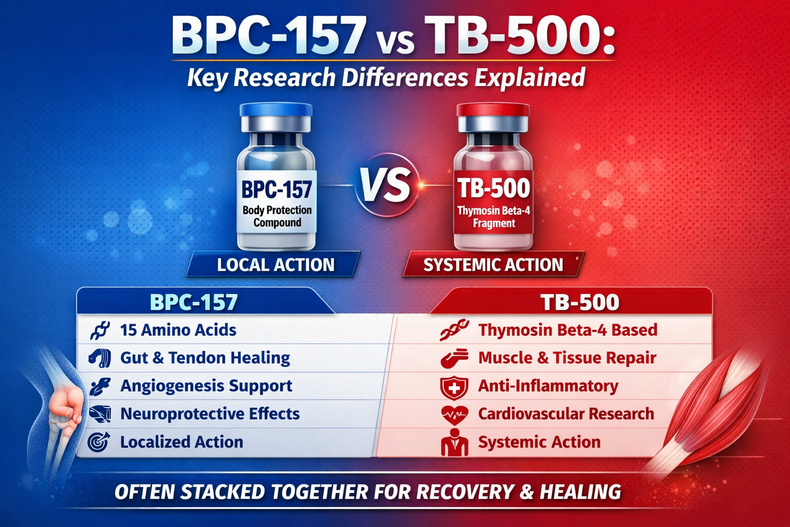
BPC-157 and TB-500 are often mentioned in the same breath, but they work completely differently. Here's how to know which one (or both) belongs in your protocol.
If you've spent any time in the peptide research space, you've seen BPC-157 and TB-500 mentioned together, often as a pair, sometimes interchangeably.
Here's the problem: they are not interchangeable. They don't work the same way. They don't target the same tissues. And if you pick the wrong one for your research goals, you're leaving real results on the table.
This isn't a knock on either peptide. Both are backed by hundreds of animal studies. Both have earned their place at the top of the recovery research conversation. But they are fundamentally different tools, and knowing which one addresses your specific goals is the difference between a protocol that works and one that doesn't.
"Think of BPC-157 as a precision scalpel, targeted, site-specific, powerful at the local level. Think of TB-500 as a full-body recovery signal. Both matter. But they're not the same job."
Let's break down exactly what each one does, what the research actually shows, and how to decide which belongs in your protocol, or whether you need both.
What Is BPC-157? (And Why Your Stomach Holds the Key)
BPC stands for Body Protection Compound. It's a synthetic peptide made of 15 amino acids, originally derived from a protein found in human gastric juice, yes, stomach fluid. That origin story isn't just trivia: it's why BPC-157 has become one of the most-studied peptides for gut-related research.
But the gut connection is just the beginning. Researchers have since investigated BPC-157 across a surprisingly wide range of tissues and systems, tendons, ligaments, bone, neurological function, and blood vessel formation.
What makes BPC-157 stand out is its local, targeted action. When administered, it concentrates its effects at or near the site of injury. It's also notable for being potentially active when taken orally, a rare characteristic among peptides that makes it especially useful for GI-related research.
- Gut lining protection & IBD models
- Tendon & ligament repair
- Bone fracture healing
- Neurological & dopamine function
- Angiogenesis (blood vessel growth)
- NSAID-induced intestinal damage
- Acts locally at injury site
- 15 amino acids, short & stable
- Potentially orally active
- Multi-pathway mechanism
- Derived from gastric protein
- Not naturally produced by the body
What Is TB-500? (The One Your Body Already Makes)
TB-500 is a synthetic fragment of Thymosin Beta-4, a peptide your body already produces naturally in nearly every tissue. Researchers identified the most biologically active portion of the full molecule and isolated it. The result is a highly bioavailable compound that travels easily and broadly throughout the body.
That systemic reach is TB-500's defining feature. Where BPC-157 is precise and localized, TB-500 is a body-wide recovery signal. It doesn't concentrate at one injury site, it tells the entire system to shift into repair mode.
This makes TB-500 particularly powerful when the injury or condition being studied is diffuse, multi-site, or systemic in nature, and it's why some of the most compelling TB-500 research involves not just muscles, but cardiac tissue recovery.
- Systemic muscle repair & recovery
- Cardiovascular tissue regeneration
- Cell migration via actin regulation
- Reducing inflammatory cytokines
- Angiogenesis at the systemic level
- Reducing scar tissue formation
- Acts systemically throughout body
- Fragment of Thymosin Beta-4
- Highly bioavailable
- Endogenous - body makes TB-4 naturally
- Travels easily to distant tissue
- Typically administered by injection
The Single Most Important Difference
You can memorize every mechanism and every study, but this one distinction is what actually determines which peptide fits your protocol:
BPC-157 = Local. It works at and near the site of administration. If you're researching a specific injury, tissue, or organ system, BPC-157 delivers precision.
TB-500 = Systemic. It circulates broadly and signals the whole body. If recovery is multi-site, diffuse, or you want body-wide anti-inflammatory and regenerative effects, TB-500 is the tool.
They don't compete. They don't cancel each other out. They operate on different pathways entirely, which is exactly why so many researchers use both.
What the Research Actually Shows
BPC-157 Research Highlights
Tendons and ligaments: Multiple rodent studies showed significantly faster tendon repair after BPC-157 administration — with measurable increases in collagen production and tensile strength in damaged tendons. This is one of BPC-157's most replicated findings.
Gut and GI protection: BPC-157 was originally studied for stomach ulcers and IBD models. Research suggests it may protect the gut lining from inflammatory damage, including injury caused by NSAIDs. Its potential oral activity makes this especially relevant — most peptides don't survive oral administration intact.
Bone healing: Animal studies on fracture repair showed BPC-157 appeared to accelerate bone regeneration — though this is a less-studied area compared to tendon work.
Neurological function: A growing body of research has explored BPC-157's potential neuroprotective properties and its effects on dopamine and serotonin systems. This is emerging, but increasingly active in the literature.
Blood vessel formation: BPC-157 promotes angiogenesis — new blood vessel growth — locally at the injury site. Since vascularity is essential to tissue repair, this is a critical mechanism.
TB-500 Research Highlights
Muscle repair: TB-500 promotes cell migration to injury sites and supports the rebuilding of damaged muscle fibers. This is where TB-500's systemic reach shines — it doesn't require precise administration near the target tissue.
Cardiac tissue: Some of the most compelling TB-500 findings come from cardiovascular research. Animal studies have explored its potential to help regenerate heart tissue after damage — a finding with significant long-term implications.
Scar tissue and flexibility: Research suggests TB-500 may reduce scar tissue formation while restoring flexibility in injured tissue — important for functional recovery, not just structural repair.
Anti-inflammation: TB-500 has demonstrated anti-inflammatory properties across multiple tissue types in animal models, contributing to faster healing across a broad range of injury scenarios.
BPC-157 vs TB-500: Full Side-by-Side Comparison
| Feature | BPC-157 | TB-500 |
|---|---|---|
| Origin | Gastric protein derivative | Thymosin Beta-4 fragment |
| Action type | Local / targeted | Systemic / body-wide |
| Gut/GI research | Extensive support | Minimal research |
| Tendon & ligament | Strongest evidence here | Some supporting evidence |
| Muscle repair | Some evidence | Strong research support |
| Cardiovascular | Limited | Compelling animal findings |
| Neurological | Growing evidence | Less studied |
| Oral activity | Potentially yes | Typically injected |
| Endogenous? | No | Yes (TB-4 is natural) |
| Best stacked with? | TB-500 | BPC-157 |
| FDA approved? | No — research use only | No — research use only |
Research-grade purity. Lab-verified. USA-based supplier with fast, reliable shipping. Trusted by researchers across the country.
Why Top Researchers Use Both — The Stack Explained
By now the logic is clear. BPC-157 handles local, precise repair. TB-500 activates the body's full-scale recovery response. They work on different pathways, different tissues, and different scales — without interfering with each other.
The BPC-157 + TB-500 stack is one of the most discussed combinations in peptide research for exactly this reason: it covers both angles simultaneously. Local and systemic. Targeted and broad. Precision and reach.
In research models where both have been studied together, the combination has been explored as a strategy for compressing recovery timelines and achieving more comprehensive tissue repair outcomes than either peptide alone.
"Neither BPC-157 nor TB-500 is a complete recovery protocol on its own. Together, they address tissue repair at two completely different levels — and that's what makes the combination so compelling in research models."
Currently in stock: BPC-157 and TB-500 are available now at Theratide USA. Inventory levels fluctuate — check current availability here.
Which Should You Research? An Honest Decision Guide
Choose BPC-157 if your research focuses on:
- Gastrointestinal health, ulcers, or inflammatory bowel models
- Tendon, ligament, or connective tissue repair
- Localized wound healing or site-specific injury recovery
- Neurological function or neuroprotection
- Oral administration protocols
Choose TB-500 if your research focuses on:
- Systemic or multi-site recovery models
- Skeletal muscle repair and regeneration
- Cardiovascular tissue or cardiac models
- Broad anti-inflammatory protocols
- Scenarios where precise injection at the injury site isn't required
Choose both if: you're running a comprehensive recovery protocol and want to cover local repair and systemic recovery simultaneously. This is the most common approach among researchers working on full-spectrum tissue regeneration models.
Both BPC-157 and TB-500 are available at Theratide USA — along with our full catalog of research-grade peptides.
Frequently Asked Questions
Can BPC-157 and TB-500 be used in the same research protocol?
Yes — and it's one of the most widely discussed combinations in peptide research. They operate on separate pathways and don't appear to interfere with each other. BPC-157 handles local repair; TB-500 handles systemic recovery. Used together, they cover both dimensions of tissue healing.
Which peptide has stronger research behind it?
BPC-157 has a slightly larger volume of published animal research, especially in tendon, ligament, and GI models. TB-500 has strong evidence in systemic muscle repair and cardiovascular tissue. Both have primarily been studied in rodent models — human clinical trials remain limited for each.
Is BPC-157 really active when taken orally?
Potentially, yes — which is unusual for a peptide. Most peptides break down in the digestive system before they can act. BPC-157 appears to retain some biological activity orally, which is one reason it's particularly relevant for gut and GI research models.
Are BPC-157 and TB-500 safe for human use?
Neither BPC-157 nor TB-500 is approved by the FDA for human use. Both are sold and researched as research-use-only compounds. All products at Theratide USA are intended strictly for laboratory and research purposes and are not for human consumption.
Where can I buy research-grade BPC-157 and TB-500?
Theratide USA carries both peptides in research grade. Visit theratideusa.com/shop to see current inventory, specifications, and pricing.
Ready to Build Your Research Protocol?
Theratide USA supplies research-grade BPC-157, TB-500, and the full BPC-157 + TB-500 stack. Lab-verified purity. USA-based. Ships fast.
For research purposes only. Not for human consumption.
Disclaimer: All products sold by Theratide USA are intended for laboratory and in-vitro research purposes only. BPC-157 and TB-500 are not approved by the FDA for human use and are not intended to diagnose, treat, cure, or prevent any disease or medical condition. This article is for informational purposes only and does not constitute medical or clinical advice. Research referenced herein was conducted in animal models and may not translate to human outcomes. Always comply with applicable federal, state, and local laws and regulations. By purchasing from Theratide USA you confirm that you are a qualified researcher and that the products will be used solely for lawful research purposes.
Shop BPC-157 & TB-500Research-grade. Ships fast from the USA.
Shop Now →