

Lyophilized Peptides:
These peptides are freeze-dried, a process that helps support shelf life while preserving the purity and integrity of the peptides during storage.
These peptides are freeze-dried, a process that helps support shelf life while preserving the purity and integrity of the peptides during storage.
COA Documentation:
Every product is supported by batch-specific documentation so researchers can review purity, identity, and quality information before use.
Every product is supported by batch-specific documentation so researchers can review purity, identity, and quality information before use.
99%+ Research-Grade Purity:
Our research peptide products are offered in a 99%+ research-grade purity format and are tested to confirm quality, identity, and consistency.
Our research peptide products are offered in a 99%+ research-grade purity format and are tested to confirm quality, identity, and consistency.
Product Overview
What is BPC-157?
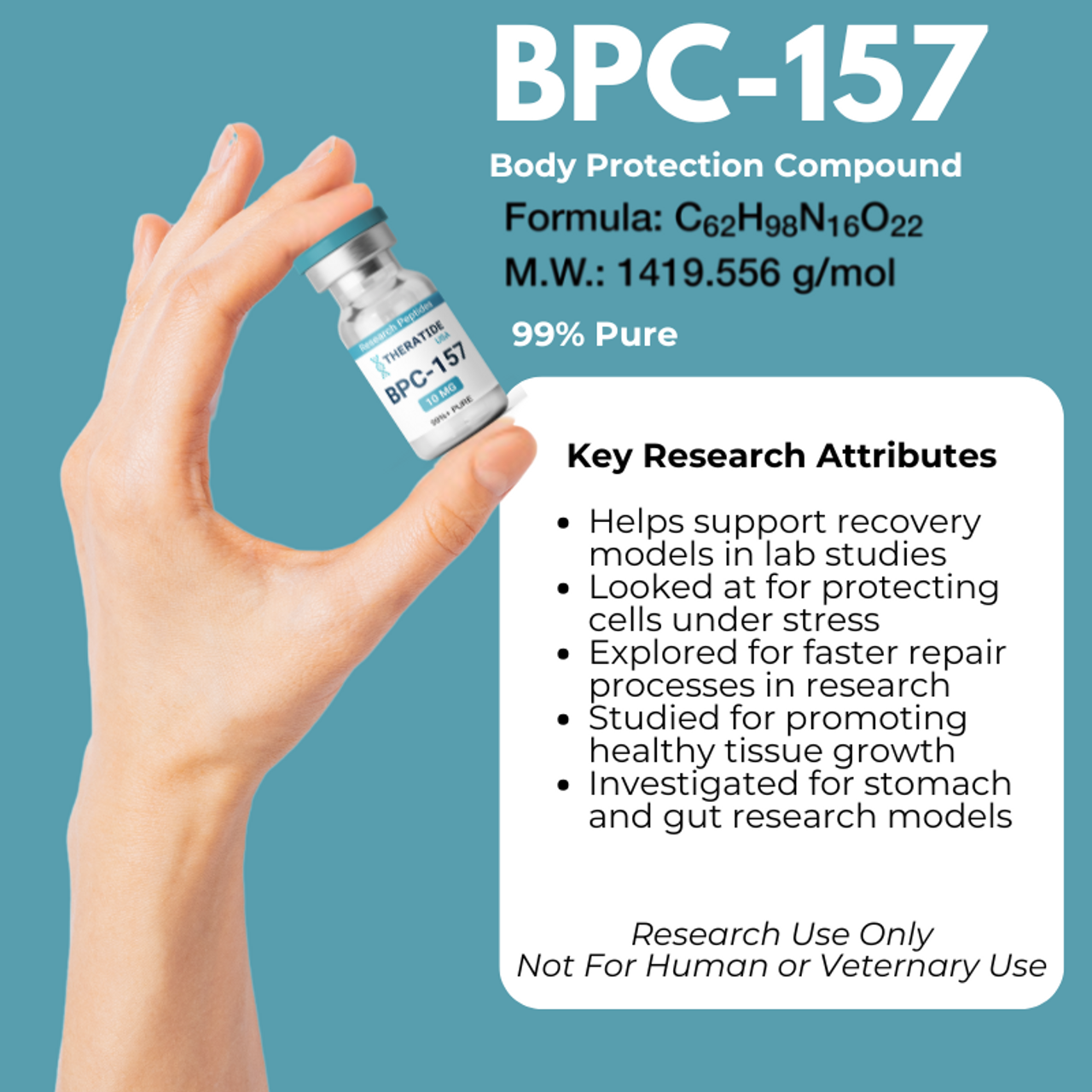
BPC-157, short for Body Protection Compound-157, is a derivative of a naturally occurring protein in the digestive tract that promotes healing, protects the GI lining, and stimulates blood vessel growth.
- Wound healing
- Blood vessel growth
- The coagulation cascade
- Nitric oxide generation
- Immune system function
- Gene expression
- Hormone regulation
BPC-157 Peptide Structure
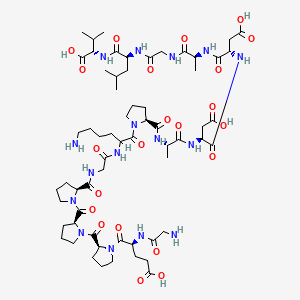
Sequence: Gly-Glu-Pro-Pro-Pro-Gly-Lys-Pro-Ala-Asp-Asp-Ala-Gly-Leu-Val
Molecular Formula: C62H98N16O22
Molecular Weight: 1419.556 g/mol
PubChem CID: 108101
BPC-157 Peptide Research
- Wound Healing: Promotes fibroblast activity and extracellular matrix repair.
- Vascular Growth: Stimulates angiogenesis and collateral blood vessel formation.
- Tendon Healing: Improves tendon, ligament, and bone healing.
- Antioxidant Properties: Neutralizes oxidative stress and supports GI health.
- Drug Side Effects: Counters NSAID-induced damage and protects against arrhythmias.
- Bee Research: Shown to improve honeybee gut health and hive survival.
Future BPC-157 Research
Ongoing research is investigating its roles in angiogenesis, cancer development, and embryogenesis, highlighting its wide therapeutic potential.
Referenced Citations
- T. Huang et al., “Body protective compound-157 enhances alkali-burn wound healing in vivo and promotes proliferation, migration, and angiogenesis in vitro,” Drug Des. Devel. Ther., vol. 9, pp. 2485–2499, 2015.
- D. Drmic et al., “Counteraction of perforated cecum lesions in rats: Effects of pentadecapeptide BPC 157, L-NAME and L-arginine,” World J. Gastroenterol., vol. 24, no. 48, pp. 5462–5476, Dec. 2018.
- F. Amic et al., “Bypassing major venous occlusion and duodenal lesions in rats, and therapy with the stable gastric pentadecapeptide BPC 157, L-NAME and L-arginine,” World J. Gastroenterol., vol. 24, no. 47, pp. 5366–5378, Dec. 2018.
- A. Duzel et al., “Stable gastric pentadecapeptide BPC 157 in the treatment of colitis and ischemia and reperfusion in rats: New insights,” World J. Gastroenterol., vol. 23, no. 48, pp. 8465–8488, Dec. 2017.
- J. Vukojević et al., “Rat inferior caval vein (ICV) ligature and particular new insights with the stable gastric pentadecapeptide BPC 157,” Vascul. Pharmacol., vol. 106, pp. 54–66, 2018.
- D. Drmic et al., “Celecoxib-induced gastrointestinal, liver and brain lesions in rats, counteraction by BPC 157 or L-arginine, aggravation by L-NAME,” World J. Gastroenterol., vol. 23, no. 29, pp. 5304–5312, Aug. 2017.
- M.-J. Hsieh et al., “Therapeutic potential of pro-angiogenic BPC157 is associated with VEGFR2 activation and up-regulation,” J. Mol. Med. Berl. Ger., vol. 95, no. 3, pp. 323–333, 2017.
- Z. Grabarevic et al., “The influence of BPC 157 on nitric oxide agonist and antagonist induced lesions in broiler chicks,” J. Physiol. Paris, vol. 91, no. 3–5, pp. 139–149, Oct. 1997.
- P. Sikiric et al., “Novel Cytoprotective Mediator, Stable Gastric Pentadecapeptide BPC 157. Vascular Recruitment and Gastrointestinal Tract Healing,” Curr. Pharm. Des., vol. 24, no. 18, pp. 1990–2001, 2018.
- S. Seiwerth et al., “BPC 157 and Standard Angiogenic Growth Factors. Gastrointestinal Tract Healing, Lessons from Tendon, Ligament, Muscle and Bone Healing,” Curr. Pharm. Des., vol. 24, no. 18, pp. 1972–1989, 2018.
- C.-H. Chang et al., “The promoting effect of pentadecapeptide BPC 157 on tendon healing involves tendon outgrowth, cell survival, and cell migration,” J. Appl. Physiol., vol. 110, no. 3, pp. 774–780, Oct. 2010.
- Y.-L. Hu et al., “FAK and paxillin dynamics at focal adhesions in the protrusions of migrating cells,” Sci. Rep., vol. 4, p. 6024, Aug. 2014.
- K. Škrlec et al., “Engineering recombinant Lactococcus lactis as a delivery vehicle for BPC-157 peptide with antioxidant activities,” Appl. Microbiol. Biotechnol., vol. 102, no. 23, pp. 10103–10117, Dec. 2018.
- D. Strinic et al., “BPC 157 counteracts QTc prolongation induced by haloperidol, fluphenazine, clozapine, olanzapine, quetiapine, sulpiride, and metoclopramide in rats,” Life Sci., vol. 186, pp. 66–79, Oct. 2017.
- N. Jelovac et al., “Pentadecapeptide BPC 157 attenuates disturbances induced by neuroleptics: the effect on catalepsy and gastric ulcers in mice and rats,” Eur. J. Pharmacol., vol. 379, no. 1, pp. 19–31, Aug. 1999.
- I. Tlak Gajger et al., “Stable gastric pentadecapeptide BPC 157 in honeybee (Apis mellifera) therapy, to control Nosema ceranae invasions in apiary conditions,” J. Vet. Pharmacol. Ther., vol. 41, no. 4, pp. 614–621, Aug. 2018.
Related products
-
Ipamorelin
Price range: $49.99 through $80.00
You save (%) -
BPC-157 + TB-500 20mg (Wolverine Blend)
$120.00
You save (%) -
Epitalon Capsules 3.3mg
$199.99
You save (%) -
Epithalon 10MG
$45.00
You save (%) -
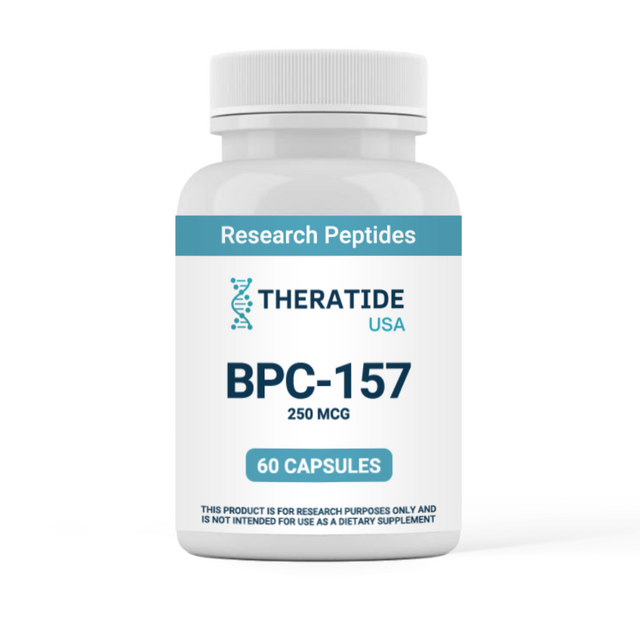
BPC-157 Capsules 250mcg (60 count)
$103.39
You save (%)